Your anxiety was never a mindset problem.
It lives in Primitive Reflexes that were meant to integrate in your first year of life — and didn’t. I help women switch Reflexes off at source, so calm becomes your body’s natural state again. Not something you achieve – It’s something you return to.
Half an hour. You’ll leave with one technique to use the same day — whether or not we ever work together.
You've held it together for years. It's exhausting, isn't it?
You’ve tried. The therapy. The books. The breathing apps, the journals, perhaps the medication. Some of it helped, for a while. But the anxiety always comes back, humming underneath everything — until you start to wonder whether this is simply who you are.
It isn’t. And it was never your fault.
The dread that arrives before the meeting does. The racing heart when the phone rings. Saying no to the party again — not because you don’t want to go, but because you already know your body will be overwhelmed if you do.
From the outside, you’re capable. Organised. The one person they lean on. Nobody would guess that you’re managing yourself minute by minute, or that you fall apart quietly at home where no one can see.
Here's what nobody has told you.
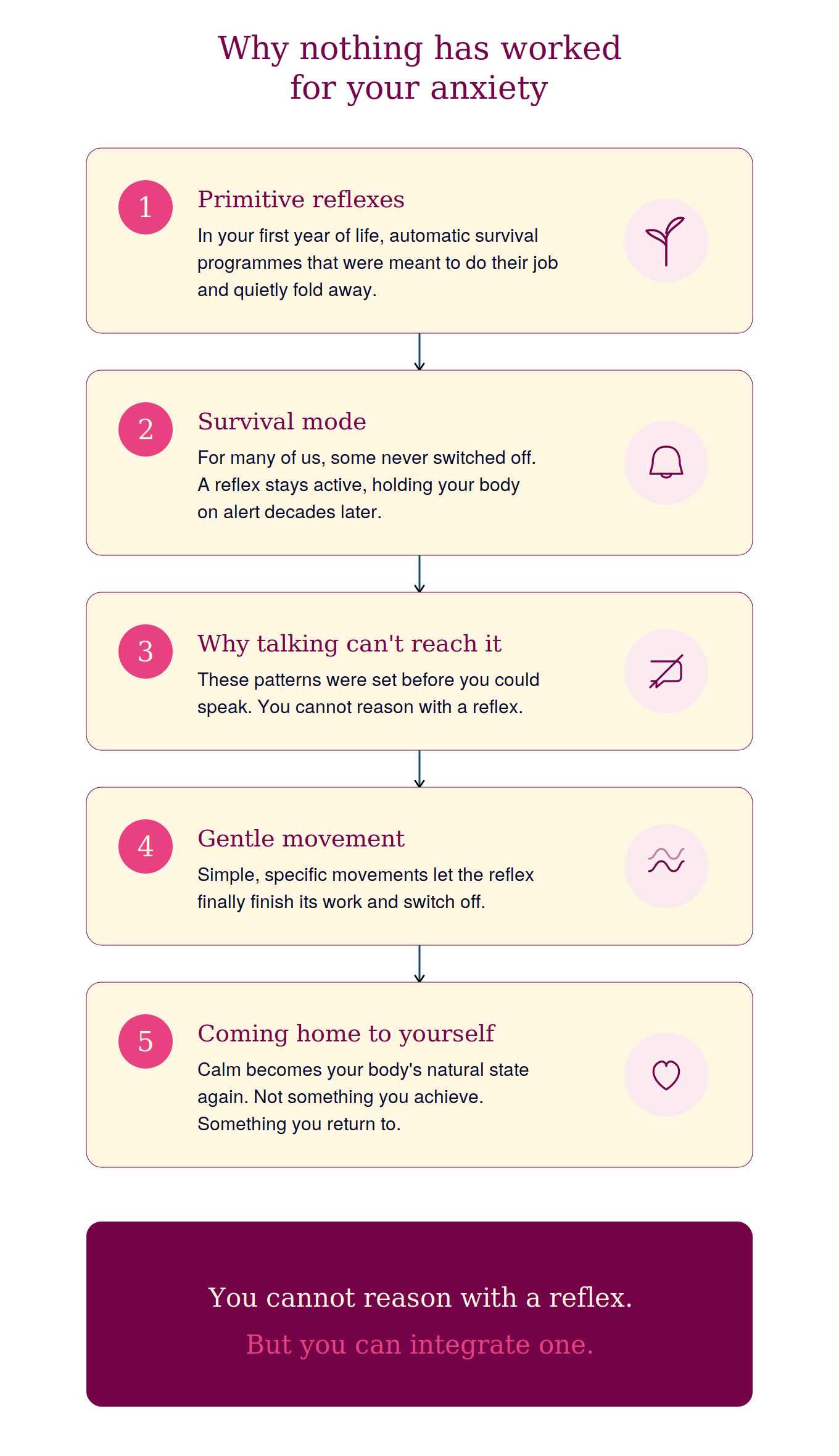
In your first year of life, your body ran on a set of automatic survival programmes called primitive reflexes. They were meant to do their job and then integrate, fold quietly away as your nervous system matured.
For many of us, some of them never did. Birth trauma, early stress, sometimes nothing you could point to at al, and a reflex stays active, holding your body in survival mode decades later. Your system behaves as though the danger is still here. Because as far as your reflexes are concerned, it is.
This is why talking hasn’t fixed it. These patterns were set before you could speak, and you cannot reason with a reflex. No amount of mindset work reaches a pattern that lives below thought. It’s so familiar to you, it feels normal. It isn’t. And it can change.
The way to change it is the way it was meant to happen in the first place: through specific, simple movements that let the reflex finish its work and finally switch off. This is Primitive Reflex Integration — and it’s the foundation of everything I do.
I know, because it happened in my own body.
I had spent 25 years teaching people how to calm their nervous systems — relaxation was literally my profession — and then I discovered I had never actually been relaxed myself. I was managing my stress skilfully, but I was not free of it.
When I finally released those reflex patterns, it felt like returning to a blueprint: my body remembered how to be, naturally. Calm stopped being something I worked at and became somewhere I lived.
I wrote a book about this work, Trauma Integrated, and I’ve spent the years since helping women make the same return.
Read my Story here
The book is Here
The Journey Back to Calm
1. We talk. A free half-hour Breakthrough Session. You tell me your story; I tell you honestly what I think is happening in your nervous system — and whether I’m the right person to help. You leave with one technique to use that same day.
2. We switch off the alarm. Working together — 1:1, in a group, or through my self-paced Empowerment Toolkit — we integrate the reflexes keeping you in survival mode. The movements are simple and gentle. Most take minutes a day. You don’t need to be fit, flexible, or brave.
3. You return to yourself. Not a calmer version of the anxious you — the you from before the alarm got stuck on. Sleeping through the night. Enjoying your own family in your own kitchen. Making decisions from a settled body.
Ways to Work with me
Wherever you’d like to begin